Science & Cosmos
The Kerala School and the Birth of Calculus
Two centuries before Newton and Leibniz, Madhava of Sangamagrama was summing infinite series under the coconut palms.
Sometime around 1400 CE, in a village on the Nila river in Kerala, the astronomer Madhava of Sangamagrama wrote down what we now call the Leibniz series for pi: the circumference of a circle equals four times the diameter, minus four-thirds, plus four-fifths, and so on without end. Leibniz would find it again in 1673. Madhava did more: knowing the series converges with agonizing slowness, he derived correction terms that accelerate it, and computed pi to eleven decimal places.
A lineage, not a lone genius
Madhava founded what historians now call the Kerala school of astronomy and mathematics — a guru-shishya lineage that ran unbroken for over two centuries: Parameshvara, the great observational astronomer who spent fifty-five years refining eclipse calculations; Damodara; Nilakantha Somayaji, whose Tantrasangraha of 1501 proposed a planetary model in which the five planets orbit the sun; Jyeshthadeva, who wrote the school's masterpiece of exposition; and on to Achyuta Pisharati into the seventeenth century. The school's home was not a court or university but a scatter of villages — illams and temples along the Nila — where astronomy was a family discipline and mathematics a form of commentary.
The Yuktibhasha: proofs in prose
The school's most remarkable production may be Jyeshthadeva's Yuktibhasha (c. 1530) — written not in Sanskrit but in Malayalam, and devoted not to results but to yukti: demonstration, rationale, proof. Here the series for sine and cosine are derived by dividing an arc into vanishingly small segments and summing — with explicit handling of results equivalent to the integrals of powers — the essential moves of integral calculus, performed with full logical self-awareness a century before Europe. Historians of mathematics no longer argue about whether the Kerala school anticipated elements of calculus; they argue only about how to describe the achievement precisely.
Divide the arc without limit; sum what remains. The infinite, handled with care, yields the exact.The method of the Yuktibhasha, paraphrased
Why it stayed local — and why it matters
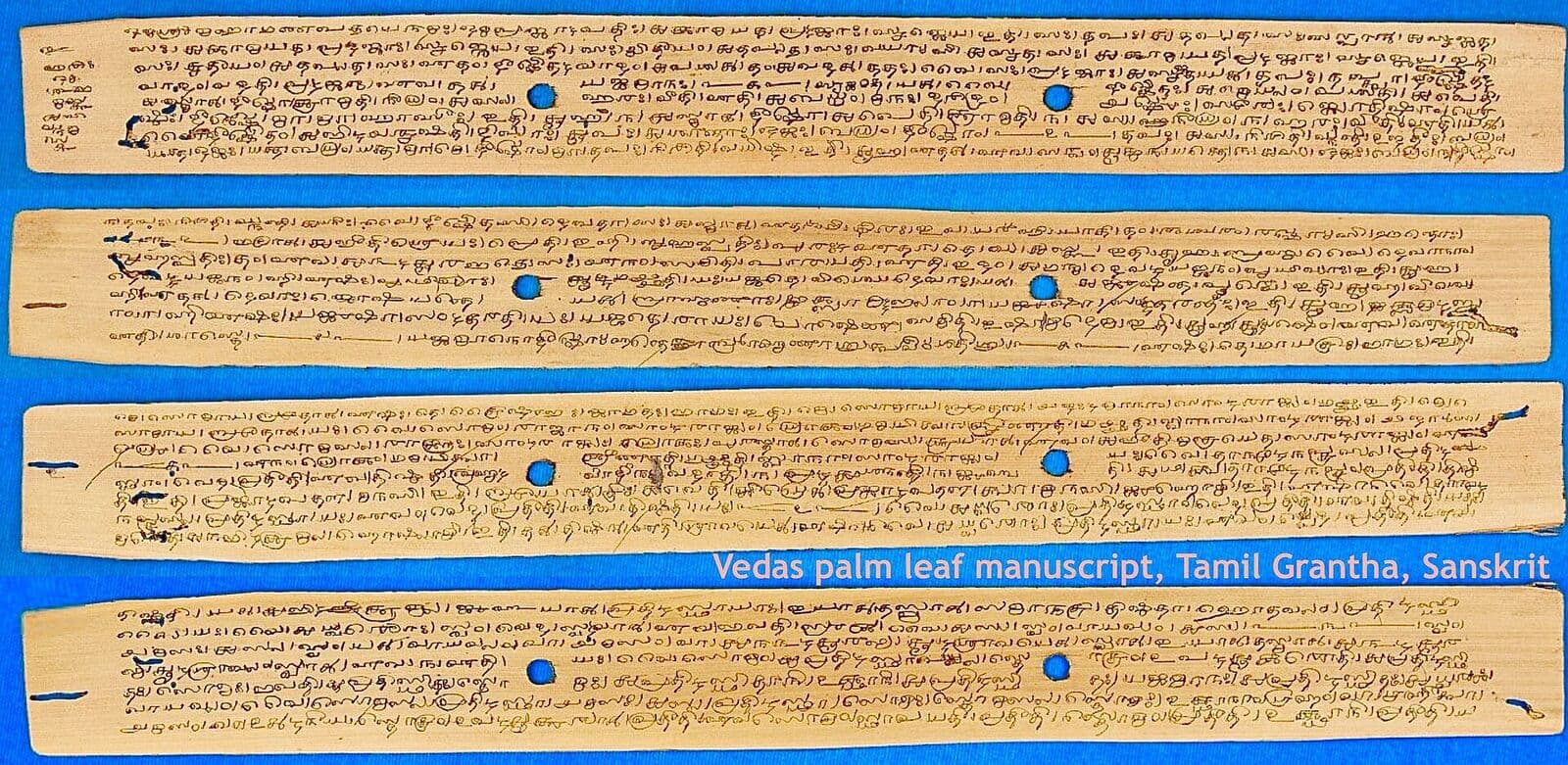
Did Kerala's mathematics reach Europe through Jesuit intermediaries and seed the calculus? The transmission thesis remains unproven, and the honest answer is that we do not know. What we do know is arresting enough. A tradition often caricatured as otherworldly sustained rigorous, cumulative, self-correcting mathematical research for ten generations, motivated by the intensely practical needs of the calendar and the intensely impractical love of exactness. The palm-leaf manuscripts were still being copied when Newton was born.
The Kerala school corrects our map of intellectual history twice over. It moves the birthplace of infinite-series analysis east by seven thousand kilometres and back by two hundred years. And it reminds us that the parampara — the same institution that carried the Vedas — could carry mathematics with equal fidelity, and did.
About the author
Prajna Insights Editorial DeskEditorial Desk
The collective byline for essays researched, drafted, and edited through the Prajna Insights editorial process, including AI-assisted drafting reviewed under Kiran Karanam's editorial responsibility.
Related Articles

Science & Cosmos
Aryabhata and the Spinning Earth
In 499 CE, a twenty-three-year-old proposed that the earth rotates and calculated pi to four decimal places.
Apr 15, 2024·9 min read
Science & Cosmos
Jyotisha: How India Read the Heavens
The Vedanga of the heavens gave India its calendars, its eclipse predictions, and some of its finest mathematics.
Feb 4, 2024·8 min read

Science & Cosmos
Zero: India's Quiet Gift to the World
Every equation on earth now runs through a symbol first treated as a number in India — the discovery that nothing is something.
Feb 25, 2024·7 min read