Science & Cosmos
Jyotisha: How India Read the Heavens
Before it was fortune-telling, jyotisha was the tradition's rigorous science of time — calendars, eclipses, and the mathematics of the sky.
Of the six Vedangas — the auxiliary sciences that serve the Veda — one looks upward. Jyotisha, 'the science of lights', earned its place for a practical reason: the Vedic sacrifice is an appointment with the cosmos, and an appointment requires a calendar. When is the new moon, exactly? When does the solstice turn? The oldest surviving text of the discipline, the Vedanga Jyotisha of Lagadha, is a manual for precisely these questions, and its computational ambition set the tone for two thousand years.
The luni-solar machine
The Indian calendar is a luni-solar reconciliation of impressive elegance. Months follow the moon; the year follows the sun; and since twelve lunar months fall about eleven days short of a solar year, the system inserts an intercalary month — the adhika masa — on a rhythm that keeps festivals from drifting through the seasons. Around this core the astronomers built the panchanga, the five-limbed almanac (lunar day, weekday, lunar mansion, yoga, karana) that still governs the timing of everything from weddings to temple consecrations. Behind its tables lies real positional astronomy: the ecliptic divided into twenty-seven nakshatras, the moon's motion tracked through them, eclipses predicted by computing the lunar nodes — mythologized as Rahu and Ketu, the shadow planets that swallow the luminaries on schedule.
A civilization that must sacrifice at the right instant will, given centuries, become excellent at astronomy.
The siddhantic ascent
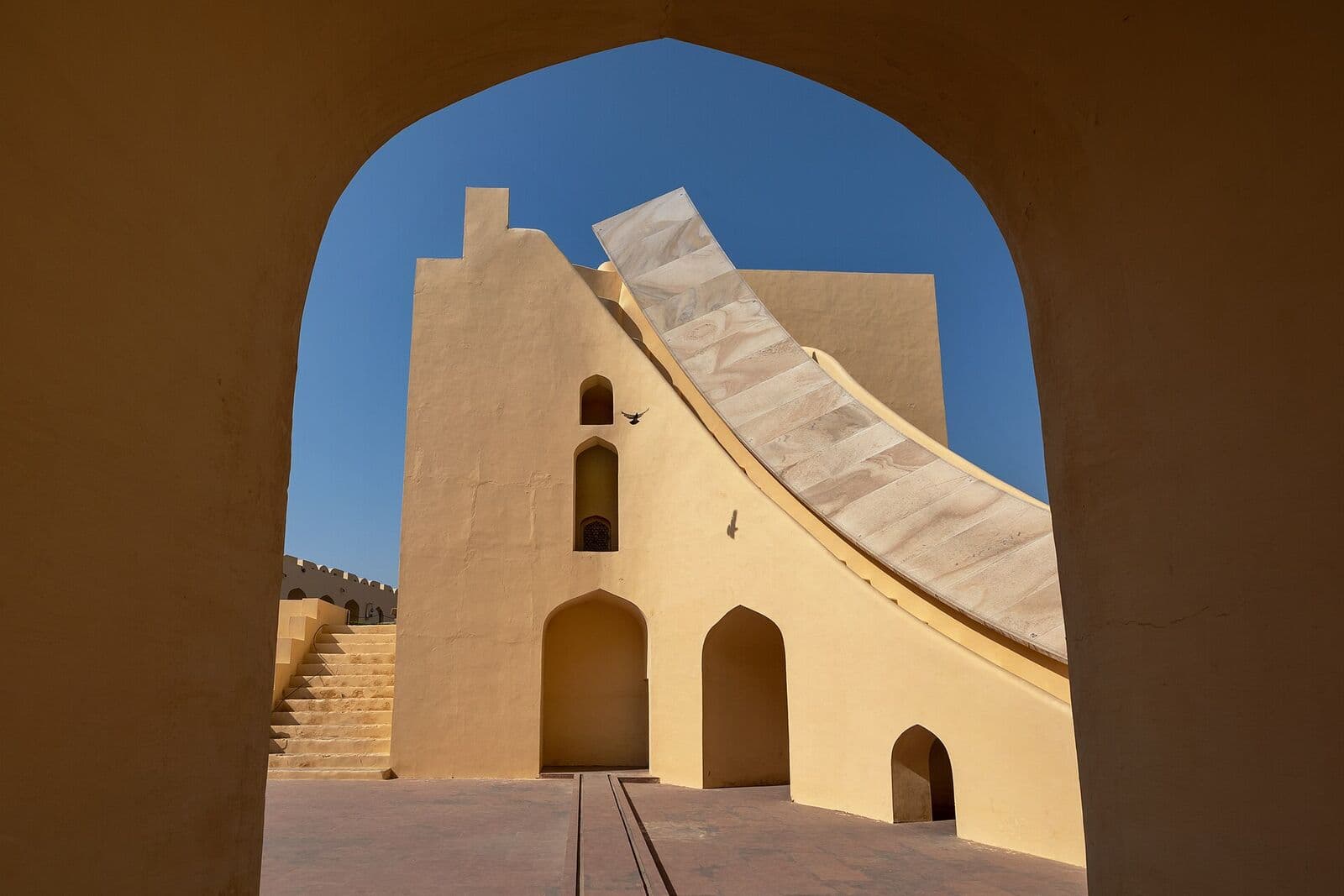
With the siddhanta texts of the classical period, jyotisha became mathematical astronomy in the fullest sense. Aryabhata computed planetary positions with epicyclic models and dared a rotating earth; Brahmagupta refined eclipse theory and interpolation methods; Bhaskara II's Siddhanta Shiromani handled planetary motion with tools at the edge of calculus. The tradition's instruments were mostly computational — verse algorithms of astonishing compression — but it built in brick and brass as well, culminating in Jai Singh II's eighteenth-century Jantar Mantars, whose giant masonry sundials at Jaipur still read local time to a couple of seconds for anyone who knows where to stand.
Science and destiny
And the horoscopes? Predictive astrology — phalita jyotisha — grew alongside the astronomy, absorbing Hellenistic elements in the early centuries CE, and became the discipline's public face. The historian's honest report is double. The computational tradition was genuine science: observational, self-correcting, mathematically fertile — the astronomers themselves distinguished ganita, calculation, from phalita, interpretation, and the greatest of them worked chiefly on the former. The interpretive tradition belongs to the history of meaning-making, not of measurement. What deserves rescue from the muddle is the achievement underneath: a civilization that, needing to meet its gods on time, built one of humanity's longest-running research programs on the mathematics of the sky — and kept its appointments for three thousand years.
About the author
Prajna Insights Editorial DeskEditorial Desk
The collective byline for essays researched, drafted, and edited through the Prajna Insights editorial process, including AI-assisted drafting reviewed under Kiran Karanam's editorial responsibility.
Related Articles
Science & Cosmos
Aryabhata and the Spinning Earth
In 499 CE, a twenty-three-year-old proposed that the earth rotates and calculated pi to four decimal places.
Apr 15, 2024·9 min read
Science & Cosmos
The Kerala School and the Birth of Calculus
Two centuries before Newton, a school of astronomer-mathematicians in Kerala discovered infinite series for pi and the trigonometric functions.
Mar 28, 2024·11 min read
History
Panini: The First Grammarian
The Ashtadhyayi generates the whole Sanskrit language from four thousand rules — a feat computer science recognized as its own ancestor.
Jan 28, 2024·10 min read