History
Panini: The First Grammarian
In under four thousand rules, a scholar of the fourth century BCE compressed an entire language — and invented formal systems on the way.
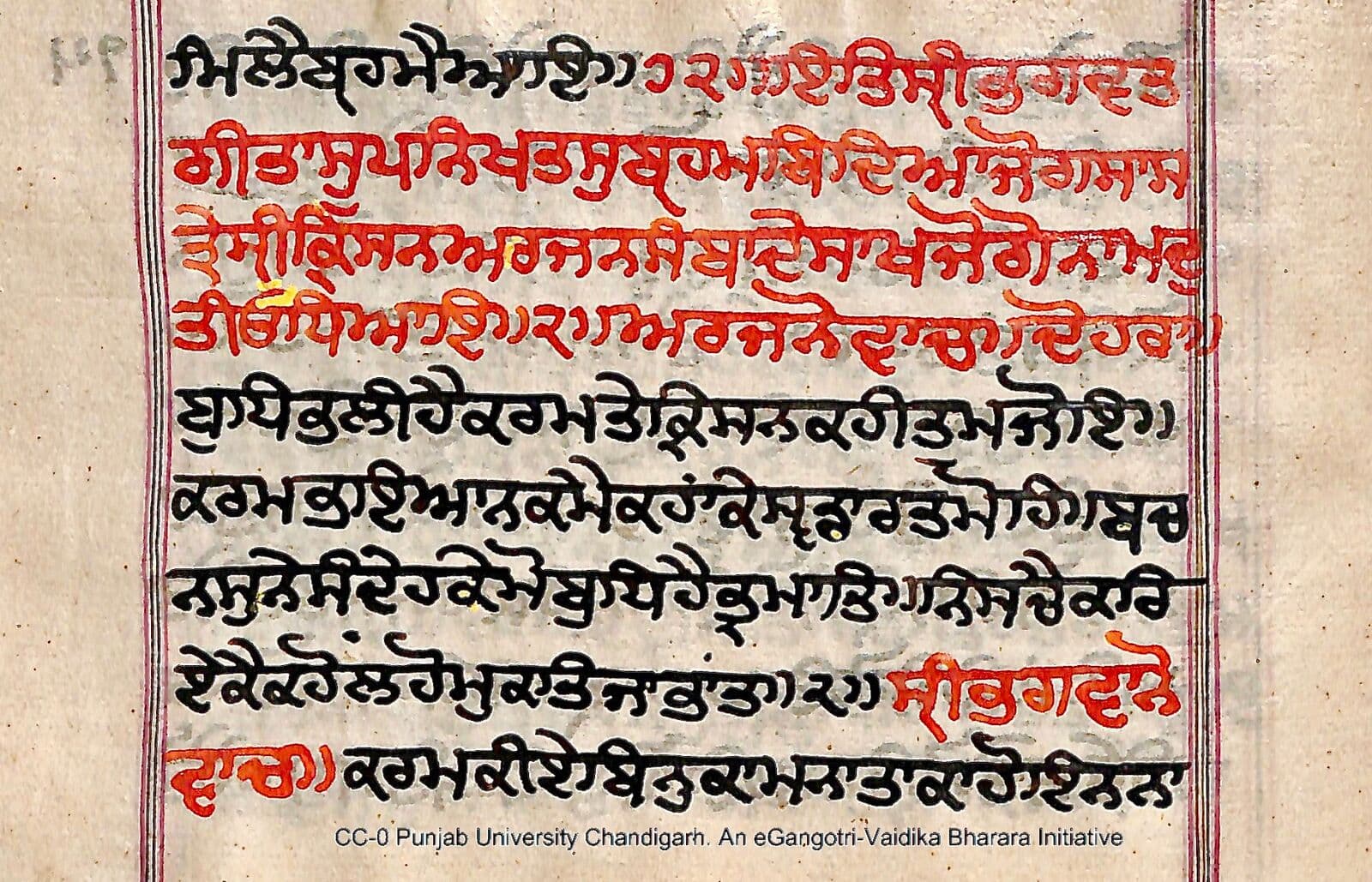
Sometime around the fourth century BCE, in the far northwest of the subcontinent, a scholar named Panini completed a work of about four thousand short rules. The Ashtadhyayi — 'eight chapters' — is not a description of Sanskrit. It is a generator of it: apply the rules correctly, and the language's entire infinity of correct forms unfolds from a finite specification. Nothing of comparable rigor about any language would exist again for over two millennia, and when modern linguistics finally caught up, it recognized the Ashtadhyayi not as a precursor but as a colleague.
The machine in eight chapters
The design is breathtakingly economical. Panini begins with the Shiva Sutras, fourteen lines arranging the sounds of Sanskrit so that whole classes can be named by a two-letter code — a compression scheme linguists still admire as near-optimal. Rules are written in an artificial metalanguage where case-endings act as operators: 'X becomes Y in context Z' is encoded grammatically, not described in prose. Rules nest; special rules override general ones by an explicit ordering principle; technical terms are defined once and reused everywhere. Sutra 1.4.2 even specifies the conflict-resolution convention. Any programmer reading a good exposition of the system experiences a shock of recognition: definitions, rewrite rules, precedence, inheritance — the architecture of a formal system, complete, from the Iron Age. The Backus–Naur notation used to define programming languages is, by its own co-inventor's acknowledgment, Paninian in spirit; computer scientists have called the Ashtadhyayi the world's first formal grammar, and periodic research papers still mine its techniques.
Panini did not describe Sanskrit. He wrote the program that outputs it.
Why grammar was sacred
It is worth asking what pressure produces such an achievement. The answer is the Veda. By Panini's time, the liturgical language was archaic; mis-recitation threatened the ritual; and grammar — vyakarana — was accordingly ranked among the six Vedangas, the sciences that guard the sacred word. Grammar in India was thus never a schoolroom chore. Patanjali's Mahabhashya, the great commentary on Panini, opens by asking why one should study grammar at all and answers first: for the protection of the Vedas. The later tradition of Bhartrihari raised the stakes further, arguing that language itself, shabda, is a form of Brahman — that reality is worded all the way down. A civilization holding that belief will fund its linguists lavishly with prestige, and did: the debates of the grammarians drew crowds, and the title vaiyakarana carried the weight 'physicist' carries today.
The longest shadow
The Ashtadhyayi froze classical Sanskrit — after Panini, correctness meant conformity to his rules, which is why a two-thousand-year-old text remains the operative standard — and through nineteenth-century European encounters with it, transformed the study of language everywhere: comparative philology, phonology, and eventually generative grammar all carry its fingerprints, a debt scholars from Saussure's teachers to Chomsky's colleagues have acknowledged. Not many human beings have built something that works, unmodified, for twenty-four centuries. Panini built a machine out of rules, and it is running in every Sanskrit sentence spoken this morning.
About the author
Prajna Insights Editorial DeskEditorial Desk
The collective byline for essays researched, drafted, and edited through the Prajna Insights editorial process, including AI-assisted drafting reviewed under Kiran Karanam's editorial responsibility.
Related Articles
Tradition
The Guru–Shishya Parampara
The living tradition of knowledge transmission in Sanatana Dharma.
May 1, 2024·9 min read
Tradition
The Sound of the Veda
How generations of reciters preserved the world's oldest continuously transmitted text — down to the pitch of every syllable.
Mar 11, 2024·9 min read

Science & Cosmos
Jyotisha: How India Read the Heavens
The Vedanga of the heavens gave India its calendars, its eclipse predictions, and some of its finest mathematics.
Feb 4, 2024·8 min read