Tradition
The Sound of the Veda
For three thousand years, the world's oldest continuous oral tradition has preserved not just words but their exact music.
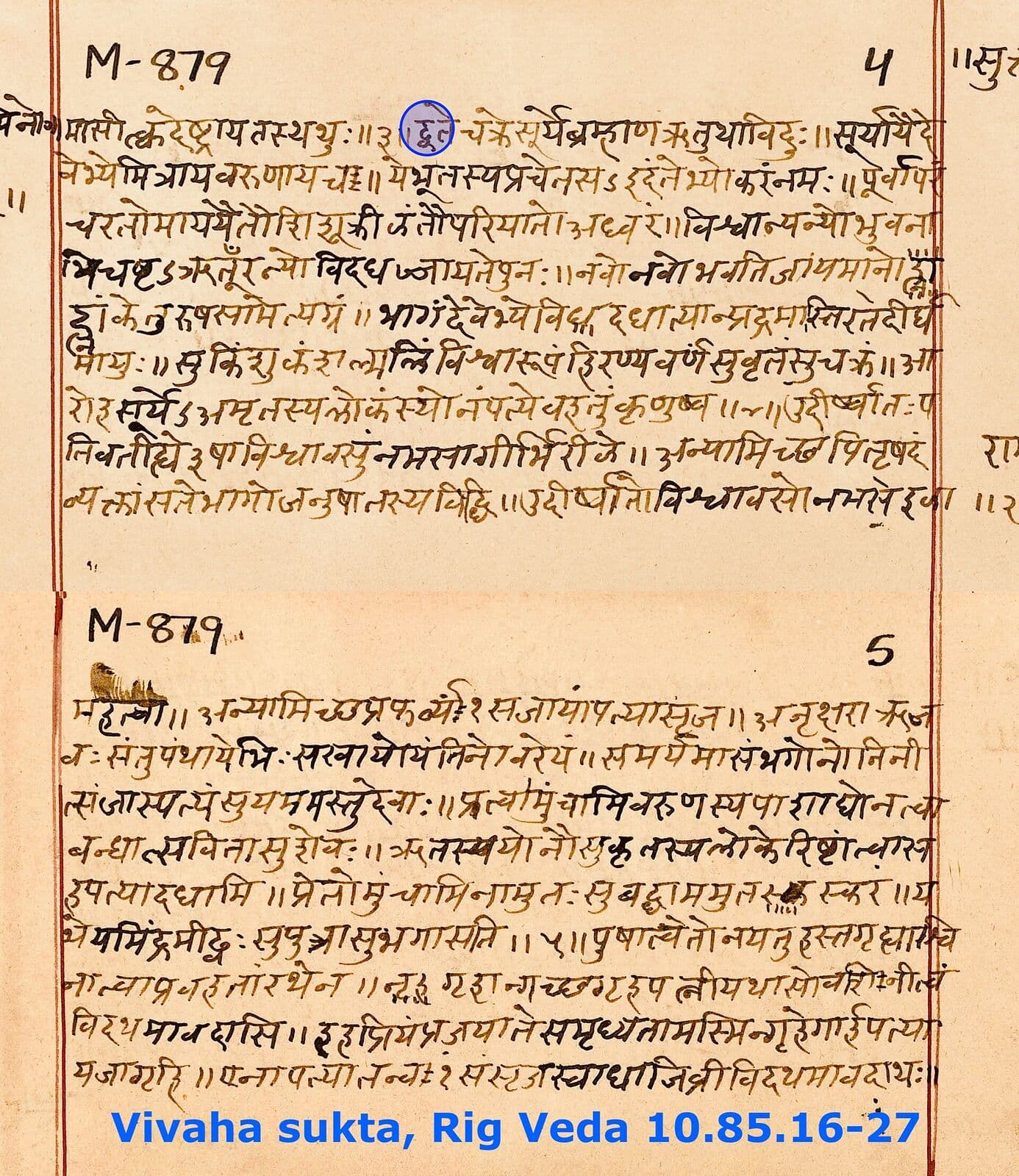
In 2003, UNESCO proclaimed Vedic chant a Masterpiece of the Oral and Intangible Heritage of Humanity. The citation had a problem no committee could solve: what the tradition preserves is not heritage in the usual sense — a ruin, a costume, a recipe. It is a sound, roughly three thousand years old, still being produced by living throats with a fidelity that manuscript cultures never achieved.
Why sound, not script
The Veda is shruti — 'the heard'. In the tradition's understanding the mantras were not composed but perceived by rishis, and their power lives in correct sound: the meaning rides the music. Writing, when it finally arrived, was regarded as a crutch — useful for the forgetful, insufficient for the real thing. A verse of the Mahabharata ranks the sellers and mis-reciters of the Veda together among its offenders. This looks like conservatism until you see the engineering it motivated.
The architecture of memory
Each syllable of a Vedic text carries a pitch — udatta, anudatta, svarita — and an error of pitch can invert a meaning; the ritual manuals preserve a cautionary tale of a sacrifice ruined by one misplaced accent. To guard against drift, the tradition built the patha system, a set of recitation permutations of increasing complexity. In samhita-patha the text flows naturally. In pada-patha, each word stands alone, sandhi dissolved. Krama braids them: ab, bc, cd. Jata weaves forward and backward: ab-ba-ab. And ghana — the 'dense' recitation that gives us the honorific ghanapathi — runs each pair through a six-fold knot: ab-ba-abc-cba-abc, bc-cb-bcd-dcb-bcd. The permutations are not performance; they are error-correcting code. A corruption that survives the forward text will collide with its mirror in jata and announce itself.
The patha permutations are error-correcting code, invented millennia before information theory had a name for what they do.
Add to this the auxiliary sciences — the Vedangas — of which four concern language: shiksha (phonetics, describing tongue positions with anatomical exactness), vyakarana (grammar), nirukta (etymology), chandas (metre). A reciter trained under this regime carries the text, its dictionary, its prosody, and its checksums in one body.
The living transmission
The results are measurable. When scholars compare Rigveda recitation recorded in Kerala, Maharashtra, and Uttar Pradesh — lineages separated by centuries and a subcontinent — the texts align to the syllable and, overwhelmingly, to the accent. Frits Staal, who documented the Nambudiri traditions, called Vedic recitation the closest thing humanity has to a tape recording made before recording existed.
It is fashionable to say such traditions are fragile, and funding appeals require it. The longer truth is stranger: papyrus rotted, libraries burned, empires that wrote everything down are legible only to specialists — while a sound entrusted to the relay of teacher and student, protected by mathematics disguised as piety, is still audible every morning. Somewhere today a seven-year-old is being taught the exact pitch at which to say agnim ile purohitam. The recording is still playing. We are inside it.
About the author
Prajna Insights Editorial DeskEditorial Desk
The collective byline for essays researched, drafted, and edited through the Prajna Insights editorial process, including AI-assisted drafting reviewed under Kiran Karanam's editorial responsibility.
Related Articles
Tradition
The Guru–Shishya Parampara
The living tradition of knowledge transmission in Sanatana Dharma.
May 1, 2024·9 min read
History
Panini: The First Grammarian
The Ashtadhyayi generates the whole Sanskrit language from four thousand rules — a feat computer science recognized as its own ancestor.
Jan 28, 2024·10 min read
Arts & Literature
Carnatic Music: The Architecture of Devotion
In the Carnatic tradition, composition is worship, the concert is liturgy, and the greatest composers are canonized as saints.
Jan 7, 2024·9 min read